

Here is what I want to say before I say anything else: ashwagandha is a real plant with a real history and real effects. It is not a vitamin. It is not something you toss into your cart alongside a multi and forget about. When I first tried Physician's Choice KSM-66 Ashwagandha, I did not do enough reading beforehand. I took it in the morning because that felt logical, I pushed the dose to 1000mg right away because the label allowed it, and for the first week I felt oddly flat and a little restless at night. I want to help you avoid my mistakes.
I have been living on the islands for 70 years. My tutu taught me that every plant has a right way and a wrong way to work with it. Ashwagandha, for all its modern packaging and clinical citations, is no different. This review covers what the marketing leaves out. If you want the straightforward experience report, the long-term piece is linked at the bottom. This one is about the caveats.
The Quick Verdict
Physician's Choice KSM-66 is a well-formulated, clinically-backed ashwagandha supplement, but it demands more care than its cheerful label suggests. Right person, right dose, right timing: genuinely helpful. Wrong fit: quietly problematic.
Amazon Check Today's Price →If you have read enough and want to know today's price, here is the link.
Physician's Choice KSM-66 Ashwagandha 1000mg, 60 vegan capsules. Check what Amazon currently has in stock and at what price before you decide.
Amazon Check Today's Price on Amazon →Who Should Not Take Ashwagandha
This is where most ashwagandha reviews skip straight to the benefits. I am going to do the opposite, because getting this wrong matters more than getting the benefits right.
If you are pregnant or trying to become pregnant, stop reading this review and skip ashwagandha entirely. Ashwagandha has traditional uses as an abortifacient, and modern research has raised enough concern that no responsible practitioner recommends it during pregnancy. That is not fearmongering. It is a basic precaution that too many supplement companies bury in fine print.
If you have a hyperthyroid condition, Graves' disease, or any diagnosis where your thyroid is already overactive, ashwagandha can push things in the wrong direction. The root has a mild thyroid-stimulating effect. That is a benefit for people with sluggish thyroids, but it is a complication for people whose thyroids are already running hot. I have a neighbor, Maile, who tried ashwagandha on her own without telling her endocrinologist. She noticed her heart rate climbing within two weeks. When she mentioned it to her doctor, he pulled her off immediately. Her thyroid levels had shifted. She is fine now, but it was an avoidable scare.
If you are in an active autoimmune flare, whether that is rheumatoid arthritis, lupus, Hashimoto's, or anything in that family, ashwagandha's immune-modulating properties can aggravate the situation. These same properties are what some researchers believe make it useful for immune resilience in healthy people, but immune modulation cuts both ways. Discuss it with your rheumatologist before you start.
Finally, if you are taking SSRIs, SNRIs, benzodiazepines, or any medication prescribed for anxiety or depression, please talk to your prescribing doctor before adding ashwagandha. Ashwagandha acts on GABA receptors, the same pathway many anti-anxiety medications target. That overlap can amplify sedation in some people and create unpredictable interactions. It does not mean the combination is always dangerous, but it means you deserve an informed conversation, not a supplement company's silence on the subject.

The 'Feeling Flat' Problem Nobody Warns You About
When ashwagandha is working for you, the sensation is subtle. The sharp edge of anxiety softens. Sleep comes more readily. You feel steadier. But a meaningful number of people, and based on the 1-star reviews in the Amazon listing these are not rare exceptions, report something different: a kind of emotional blunting. They call it feeling flat, muted, or disconnected. Some describe losing interest in things they normally enjoy.
This appears to happen most often at higher doses, and it seems more likely in people who were not running extremely high cortisol to begin with. If your stress is moderate and your nervous system is not in chronic overdrive, 1000mg daily may be pushing further than you actually need. When I dialed back to 600mg, taken at night only, the flatness lifted for me. The calm stayed. That adjustment made all the difference.
The clinical studies that support KSM-66 typically use 300mg twice daily or 600mg once daily. The 1000mg in this formulation is at the high end of what the research covers. It is legal, it is within the label's guidance, and it works well for some people. But it is worth knowing that more is not always better with adaptogens. My suggestion: start with one capsule at 500mg for the first two weeks before moving to two.
When I dialed back to 600mg, taken at night only, the flatness lifted. The calm stayed. That adjustment made all the difference.
Dose Timing: The Mistake That Turns Calm Into Restlessness
I took ashwagandha in the morning for the first week because the label says you can. It is technically true. But for many people, particularly those who are already reasonably alert in the mornings, morning dosing can create a paradoxical effect: mild restlessness, a vague scattered feeling, and, ironically, worse sleep that night.
Ashwagandha's primary mechanism involves lowering cortisol, particularly the evening cortisol spike that keeps people wired and awake when they should be winding down. If you take it in the morning when cortisol is naturally and appropriately elevated (your body needs that morning rise to get moving), you may be working against your own biology. The sweet spot for most people is 60 to 90 minutes before bed, with a small amount of food to prevent any stomach upset. That is when the cortisol-lowering effect does its most useful work.
There are exceptions. People dealing with all-day anxiety, not just the nighttime variety, sometimes split the dose, one capsule in the morning with food and one in the evening. If you go that route, keep the morning dose to 300mg or 500mg and give yourself at least two weeks before judging the results. Adaptogens are not fast-acting like caffeine or melatonin. They work gradually, recalibrating your stress response system over weeks, not hours.
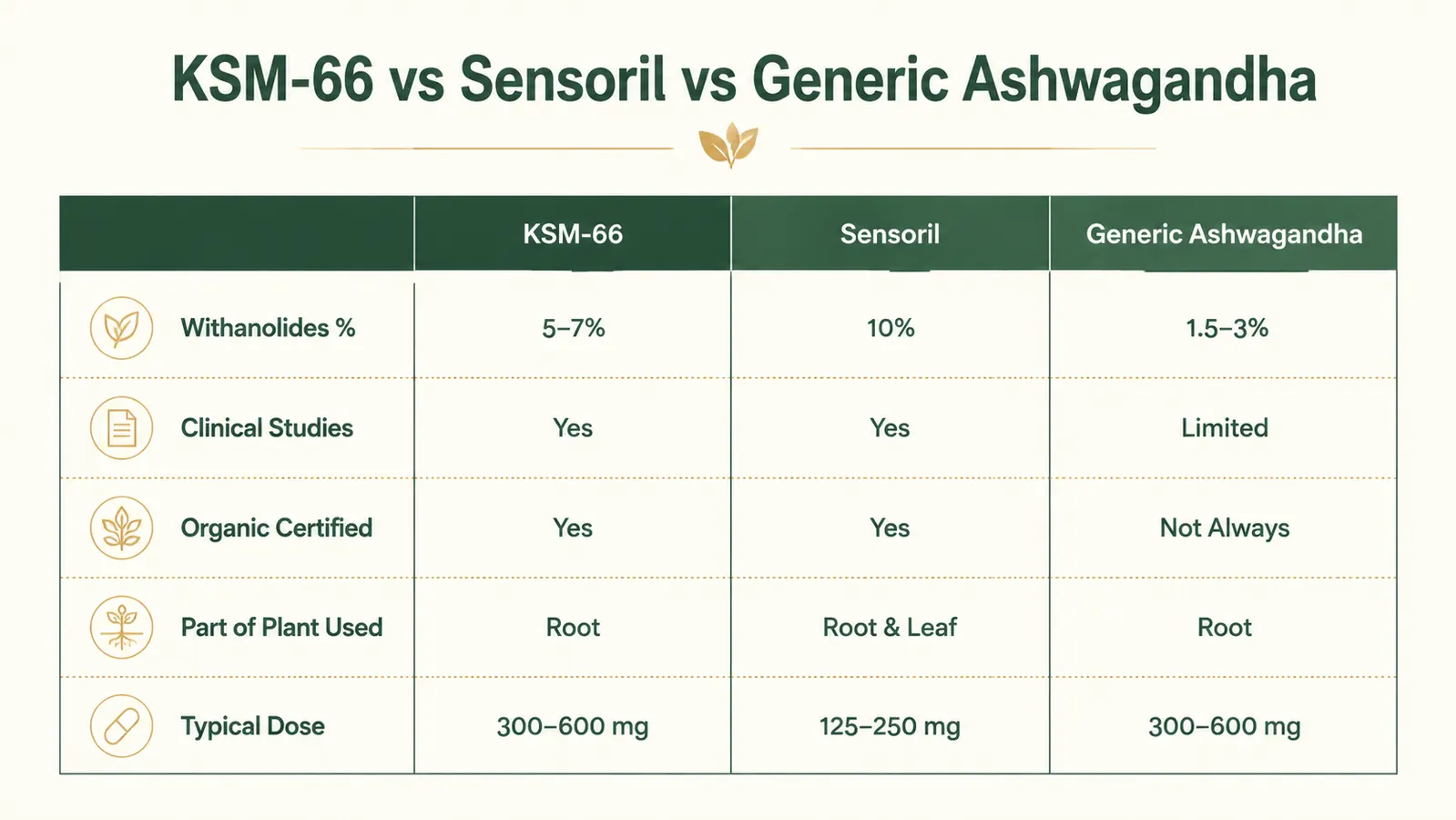
KSM-66 vs Sensoril vs Generic: What the Labels Actually Mean
Physician's Choice uses KSM-66, which is one of two widely recognized ashwagandha extracts backed by clinical research. The other is Sensoril. Generic ashwagandha root powder, which fills the majority of cheap capsules on the market, is a third category entirely. Understanding the difference matters if you are spending money on this category.
KSM-66 is made from the root of the ashwagandha plant using a water-based extraction process that concentrates withanolides, the active compounds, to at least 5%. It has been used in more than two dozen peer-reviewed clinical studies. It is organically grown in India and has both organic and non-GMO certifications. The Physician's Choice product specifies 5% withanolides on its label, which matches the KSM-66 standard.
Sensoril, by contrast, uses both root and leaf material and concentrates withanolides to 10%. It is studied at lower doses, typically 125mg to 250mg, and the clinical evidence base is smaller but still credible. Neither is objectively superior. KSM-66 has more total clinical studies; Sensoril produces a higher withanolide percentage at a smaller dose. If you see a product boasting 10% or higher withanolides, it is likely Sensoril or a proprietary blend trying to sound like Sensoril.
Generic ashwagandha root powder, the stuff in unlabeled capsules at dollar-store supplement brands, is typically unextracted or very lightly extracted, with withanolide content that is inconsistent and usually lower than claimed. It is not necessarily dangerous, but you have no meaningful way to know what you are getting. The research on KSM-66 does not transfer to generic powders just because they both say ashwagandha on the label.
| Feature | KSM-66 (this product) | Sensoril | Generic Root Powder |
|---|---|---|---|
| Withanolide % | 5% guaranteed | 10% guaranteed | Inconsistent, often 1-3% |
| Plant part used | Root only | Root and leaf | Root (usually) |
| Typical clinical dose | 300-600mg | 125-250mg | Not standardized |
| Peer-reviewed studies | 24+ published | 8-12 published | Minimal to none |
| Organic certified | Yes (KSM-66) | Varies by brand | Varies by brand |
| Cost per serving | Moderate | Moderate to high | Low |
What the Marketing Leaves Out
The Physician's Choice label says this product supports stress, mood, and athletic performance. That framing is accurate as far as it goes, but it leaves out a few things I think buyers deserve to know.
First, the research on ashwagandha for stress reduction shows meaningful results in people with clinically elevated cortisol. If your cortisol is normal and your stress is situational, like a hard week at work rather than a chronic dysregulated nervous system, you may notice much less than the clinical trial participants did. Managing your expectations around this matters.
Second, ashwagandha does affect testosterone levels in men. The research is real and replicated. But the effect size is modest, roughly a 15% increase in some studies. The supplement industry has latched onto this finding and inflated it into T-booster marketing that implies dramatic changes. What you are more likely to notice, if you notice anything, is a modest improvement in energy and possibly in exercise recovery. Keep that in perspective.
Third, this product contains black pepper extract (BioPerine) for absorption. That is a thoughtful addition. But black pepper can irritate some people's GI systems, particularly those with acid reflux or sensitive stomachs. Take it with food. Every time. Non-negotiable.
Fourth, the bottle gives you 60 capsules, which is a 30-day supply at the full 1000mg dose. If you run it at 600mg as I do, you get 50 days per bottle. That changes the value calculation in your favor.
What I Liked
- KSM-66 is a legitimate, clinically studied extract with verified 5% withanolides
- Black pepper (BioPerine) improves absorption, which generic ashwagandha products skip
- Vegan capsules, organic ashwagandha, no unnecessary fillers
- High review volume (7,500+) with a solid average rating across a broad user base
- Meaningful cortisol-lowering effect at correct dose and timing for appropriate users
- Third-party tested and manufactured in a cGMP-certified facility
Where It Falls Short
- No upfront warnings about pregnancy, thyroid, autoimmune, or medication interactions
- 1000mg full dose can cause emotional blunting, especially in people with moderate baseline stress
- Morning dosing instruction on label may worsen restlessness for many users
- Black pepper extract may cause GI discomfort without food
- Effects are gradual, 3-6 weeks minimum. Not suitable for acute stress relief
- Only a 30-day supply at the recommended dose; cost adds up month to month

Who This Is For
Physician's Choice KSM-66 is a good fit if you are a reasonably healthy adult dealing with chronic, low-grade stress and disrupted sleep. The ideal user is someone whose nervous system has been in a slow simmer for months or years, not someone in acute crisis. You are not on thyroid medication, not pregnant, not in an autoimmune flare, and not taking medication that affects serotonin or GABA. You are willing to take it at night, start at one capsule, and give it six weeks before deciding if it is working. If that is you, this is one of the better-formulated products in this category.
I also think it is worth noting that at 70, my relationship with stress is different from what it was at 40. The urgency has quieted. The ashwagandha did not change my life. But it helped my evenings feel less like the day was still pulling at me. For an older adult looking for that specific kind of relief, gentle and consistent rather than dramatic, this product delivers.
Who Should Skip It
Skip Physician's Choice KSM-66 if you are pregnant, trying to conceive, or nursing. Skip it if you have Graves' disease or hyperthyroidism, or if your most recent thyroid panel showed elevated T3 or T4 without a clear diagnosis yet. Skip it if you are currently in a flare of an autoimmune condition. Skip it if you are on SSRIs, SNRIs, or benzodiazepines without first speaking to your prescribing doctor. Skip it if you want fast results: ashwagandha does not work that way, and if you are in real distress, you need a different kind of support.
And please: skip the habit of buying any supplement and taking it without a few minutes of honest self-assessment. My tutu never picked a plant without knowing what it was for. She asked questions of the plant before she used it. We can do the same thing at the supplement shelf. Read the label carefully, then read what the label did not bother to say.
Still the right fit for you? Here is where to check current availability and pricing.
Physician's Choice KSM-66 Ashwagandha is available on Amazon with Buy Box pricing. Check today's price and whether it ships with Prime before adding to your routine.
Amazon Check Today's Price on Amazon →