
People ask me often enough that I should probably write it down. They hear the word adaptogen and assume ashwagandha and rhodiola are more or less the same thing with different names. They are not. I have been paying attention to how plants work on the body for most of my seventy years here in Hawaii, and these two herbs do genuinely different jobs. Choosing wrong does not hurt you, but it does leave you disappointed, and disappointment leads people to give up on things that could have genuinely helped them.
The short answer is this: if your nervous system is wound too tight, your sleep is broken, and you feel like your body forgot how to come down from tension, ashwagandha is almost certainly your herb. If you are getting reasonable rest but your mental stamina runs out by noon, or you need to push through a demanding stretch, rhodiola deserves a serious look. They solve different problems. Most people I talk to are dealing with the first one.
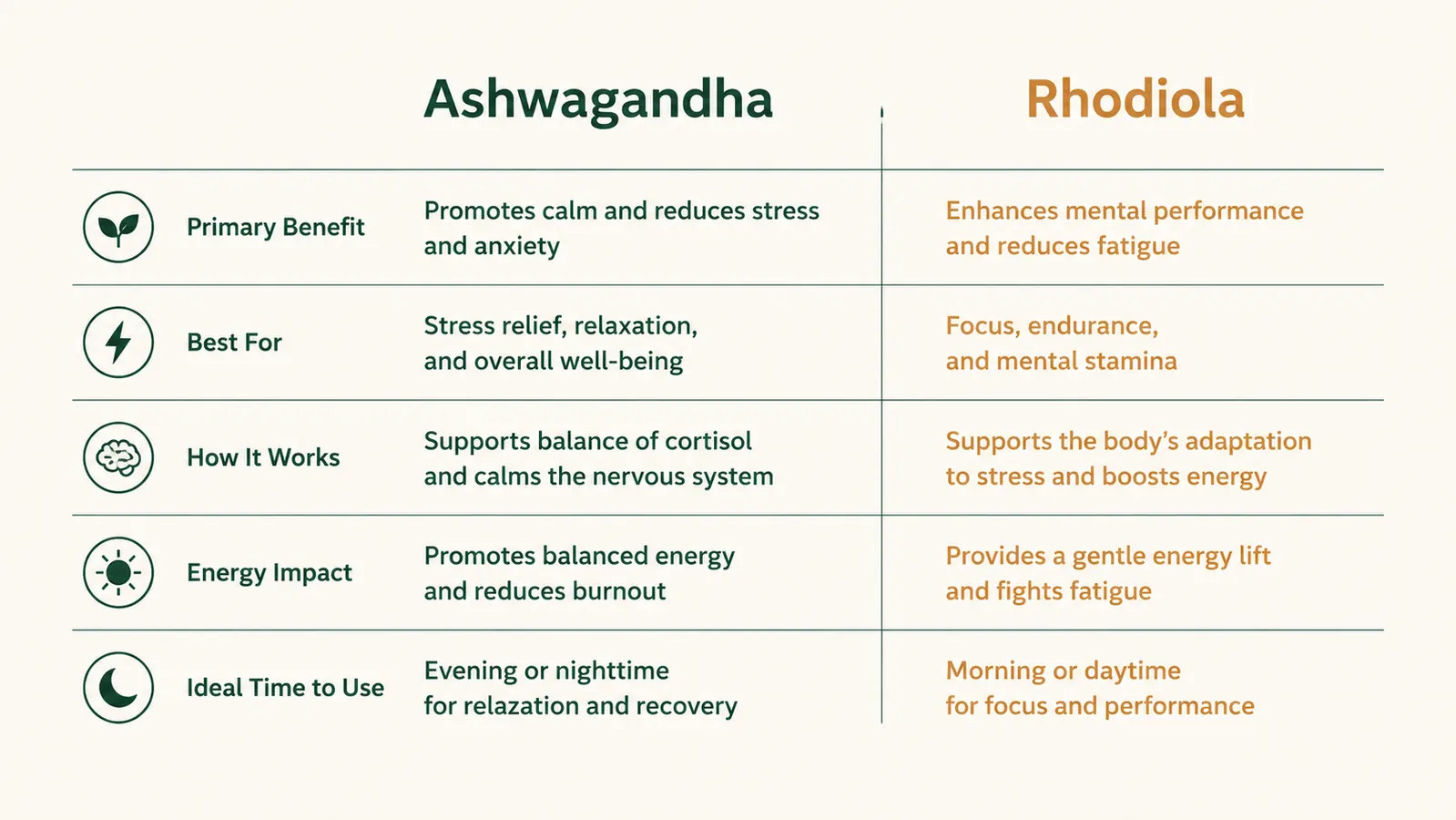
| Primary job | Calm nervous system, lower cortisol, steady sleep | Boost stamina, sharpen mental endurance under pressure |
| Best for | Chronic stress, poor sleep, anxiety, wound-too-tight feeling | Mental fatigue, athletic endurance, short-term cognitive demand |
| How it works | Regulates HPA axis, reduces cortisol over time | Activates stress proteins, increases serotonin and dopamine availability |
| Onset (typical) | 2 to 4 weeks of consistent use | Sometimes within a single dose, builds further with consistent use |
| Sleep support | Strong, helps reduce nighttime cortisol | Neutral to mildly stimulating, can disrupt sleep if taken late |
| Energy effect | Calmer, more sustainable energy over time | More immediate lift, more noticeable surge |
| Amazon link available | Yes, Physician's CHOICE KSM-66 | No, widely available, no sponsored link |
| Standardization | 5% withanolides (KSM-66 extract, the studied form) | Look for 3% rosavins + 1% salidroside as minimum standard |
| Rough cost range | Around current Amazon price for 60 caps | Varies widely by brand and extract quality |
| Who should skip it | Anyone with thyroid conditions without doctor guidance; nightshade sensitivity | Anyone with bipolar disorder; avoid if stimulant-sensitive |
Where Ashwagandha Wins
My uncle used to say that the most exhausted people he knew were not the ones who worked hardest. They were the ones whose nervous systems never rested, even when their bodies stopped moving. That is the profile ashwagandha was built for. The research on KSM-66 specifically is not thin. Multiple randomized controlled trials have looked at serum cortisol, perceived stress scales, and sleep quality, and the results hold up in ways that most supplement studies do not. The key mechanism is the HPA axis, the hormonal loop that decides how much cortisol your body pumps out. Ashwagandha appears to calm the regulation of that loop so your body stops overreacting to the small things.
The version that matters here is KSM-66, which is the root-only extract standardized to at least 5% withanolides. That standardization is not marketing language. It is the difference between a consistent dose and a bag of ground root with unknown potency. Physician's CHOICE uses KSM-66 at 1,000mg daily across two capsules and adds black pepper extract for absorption. The rating on Amazon sits at 4.5 stars across more than 7,500 reviews, which for a supplement category full of exaggerated claims is a meaningful signal. I have been using it for several months and the thing I notice most is not dramatic calm. It is the absence of the low-grade tension I had stopped noticing because it had been there so long.
Sleep is where ashwagandha stands apart from rhodiola completely. If falling asleep or staying asleep is part of your problem, rhodiola is not your answer. Some people find rhodiola mildly stimulating, especially if taken after midday. Ashwagandha, by contrast, has a small but real body of evidence supporting sleep quality improvement, including time to fall asleep and how restorative the sleep feels. For anyone over 60 whose sleep has become lighter and more fragmented, that distinction matters a great deal.
If the problem is a nervous system that forgot how to rest, this is the one I recommend.
Physician's CHOICE KSM-66 Ashwagandha uses the standardized root extract at the studied dose. Two capsules a day, with food. It is what I take.
Amazon Check Today's Price on Amazon →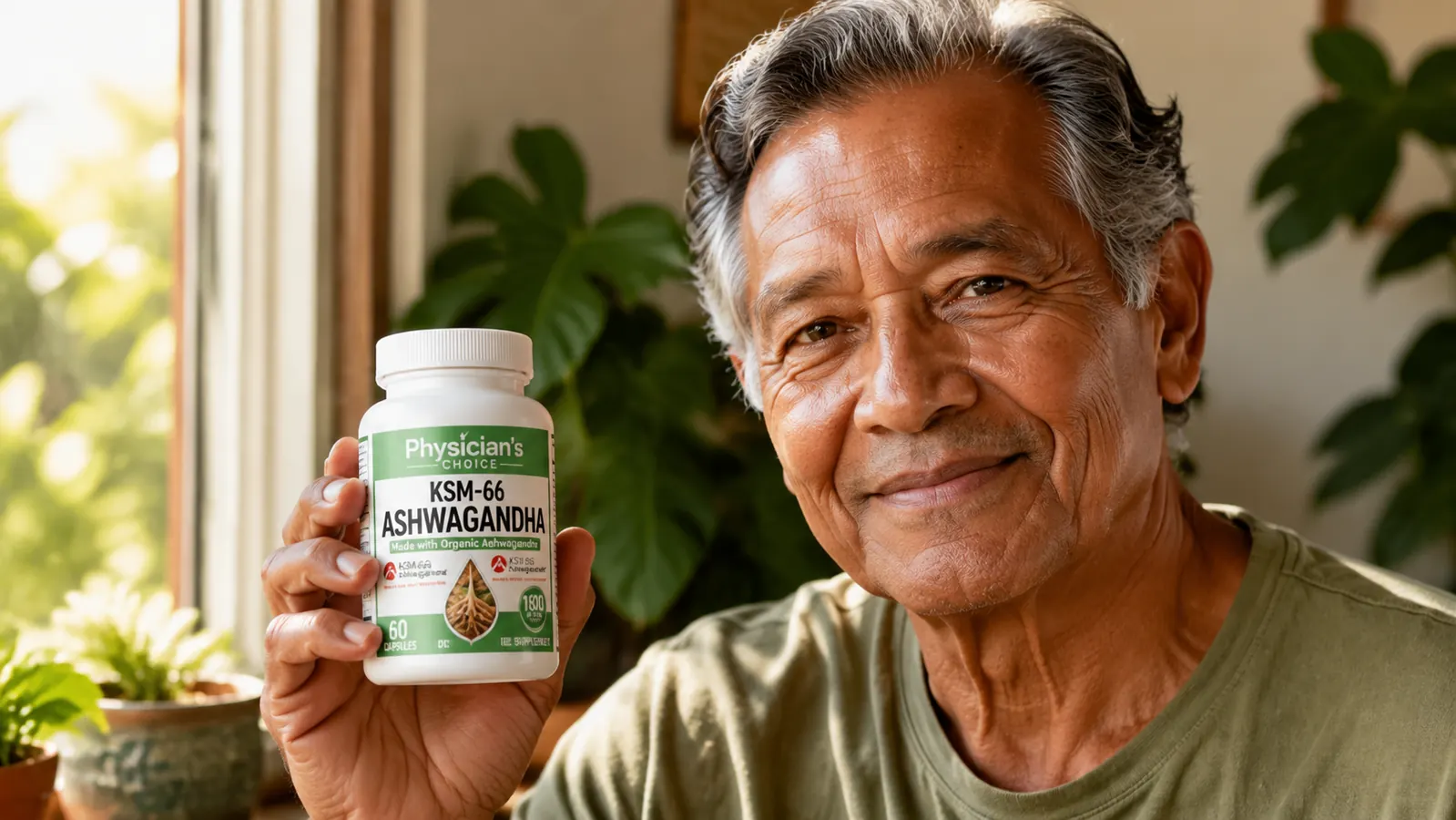
Where Rhodiola Wins
Rhodiola rosea comes from high-altitude regions of Asia and Eastern Europe, and traditional use there centered on physical endurance in harsh conditions. That origin story tells you something about its character. Where ashwagandha works gradually by recalibrating the stress hormone system over weeks, rhodiola can deliver a more immediate sense of mental sharpness. Researchers have described it as an adaptogen that activates stress-response proteins in a way that primes the body for performance rather than recovery.
For someone managing a cognitively demanding job, studying for an exam, or an athlete who needs to sustain output across a long event, rhodiola has a genuine edge. It has shown up in studies examining reaction time, mental calculation, and sustained attention under fatigue, and the results are real. The caveat is quality. The industry is full of rhodiola products using filler root powder with almost no standardized actives. You want a product showing at least 3% rosavins and 1% salidroside on the label. Without that, you are mostly paying for capsule material.
Ashwagandha calms what is already too loud. Rhodiola sharpens what is already quiet enough to hear. Mixing them up is like bringing a blanket to a race.
Who Should Buy Which
Here is the honest sort. If you lie awake at night with your thoughts running, if your shoulders sit up near your ears, if the small frustrations of the day stay with you longer than they should, ashwagandha is more likely to help you. The underlying issue is a nervous system that cannot find its way back to baseline. Rhodiola will not fix that, and in some people it will make it slightly worse because it is gently stimulating.
If your sleep is already decent, if your main complaint is that your mental energy runs out by midday or your physical performance has plateaued, rhodiola earns serious consideration. The same is true during unusually demanding periods, travel across time zones, a difficult project at work, a training block before a race. Rhodiola works well when you have a defined challenge ahead and you want to meet it without burning out.
A small number of people do well taking both, using ashwagandha in the evening for sleep support and a small dose of rhodiola in the morning for mental readiness. That is not a strategy I would start with. Get one working clearly for you first. Most people who try to fix everything at once end up not knowing what is helping. That kind of confusion is its own kind of stress.
One other consideration: if you are dealing with a thyroid condition, talk to your doctor before starting ashwagandha. There is enough evidence that it influences thyroid hormones that it warrants a conversation first, not a guess. And if you have any history of bipolar disorder, rhodiola's mild stimulant properties deserve caution. Neither of these are common disqualifiers, but they are worth knowing.

The Quality Question
Every time I write about a supplement I feel the need to say this plainly: the herb itself is not the whole story. The extract matters. The standardization matters. The manufacturing integrity matters. A bag of ashwagandha root powder from an unknown brand may have a fraction of the withanolide content you are counting on. KSM-66 is a patented extraction process that has been used in over twenty human clinical studies. When a brand builds on that, you at least know you are starting from a studied foundation. Physician's CHOICE carries that certification and tests each batch with a third party. The price point for 60 capsules, about a month's supply, is reasonable for what you are getting.
Rhodiola does not have a single dominant clinical extract the way ashwagandha has KSM-66, but the standardization ratios I mentioned above are your best screening tool. If a brand does not list rosavins and salidroside percentages on the label, pass it by. There are enough reputable brands that you do not need to guess.
My Final Take
I have watched a lot of people reach for supplements hoping to solve a problem they have not yet named clearly. The most important question you can ask before choosing between these two is simple: what is your actual complaint right now? Not a general sense that you want to feel better. What specifically is not working? If sleep and tension and the inability to wind down are on that list, ashwagandha is the more likely answer. If mental stamina and physical output are the sticking points, rhodiola belongs in the conversation.
I use Physician's CHOICE KSM-66 and have recommended it to several people in my family and on the island. The response has been consistent. Not dramatic, not overnight, but real. After a few weeks, people describe it the same way I do: something that was a little too loud got quieter. That is exactly what this herb is supposed to do. Rhodiola is genuinely useful for a different person in a different situation. Know which situation is yours before you spend your money or your patience on the wrong one.
If calm sleep and a steadier nervous system are what you need, this is a solid, well-studied starting point.
Physician's CHOICE KSM-66 Ashwagandha, 1,000mg per serving, third-party tested. More than 7,500 Amazon reviews. This is the one I keep in my cabinet.
Amazon Check Today's Price on Amazon →