

I want to tell you something about how I wound up trying an Indian root at 70 years old. Growing up on Oahu, we had la'au lapa'au, the Hawaiian practice of healing with plants. My tutu kept noni and mamaki in the yard. She knew which leaves to bruise for a headache and which bark to simmer for a stomach that would not settle. I grew up believing that the land offered what the body needed. What I did not believe, for most of my life, was that I needed help managing stress. Stress was something you breathed through. You went to the ocean. You slowed down. You talked to family. That had always been enough. Until, somewhere in my late sixties, it was not.
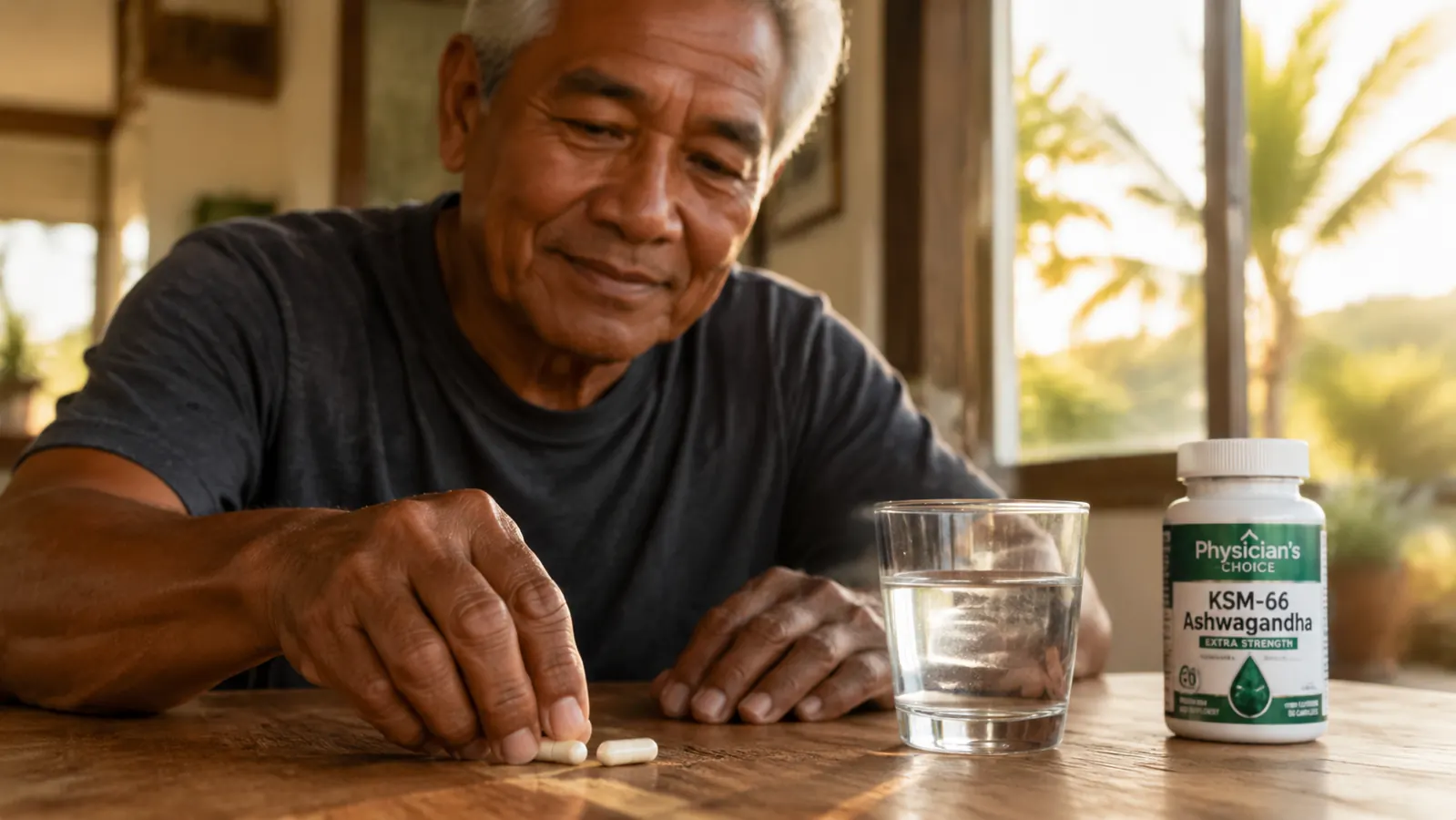
I was waking at 3 a.m. with my mind running through things I could not fix at that hour. My shoulders were carrying a tightness that the ocean could not shake loose the way it used to. A friend whose opinion I respect, a physician who practices both conventional and integrative medicine, mentioned ashwagandha. Specifically, she mentioned the KSM-66 extract form and Physician's Choice as a brand she trusted for quality and testing. I want to be honest: ashwagandha is an Ayurvedic plant, rooted in India's healing traditions, not Hawaii's. I respect those traditions. I came to this with open hands and low expectations. After 60 days, I have something worth sharing.
The Quick Verdict
A solid, well-formulated adaptogen that delivered real improvements in nighttime calm and sleep quality between weeks three and eight. Not a quick fix, not a wonder root. But for someone who has tried everything short of medication to quiet a restless mind at 70, it earned a place in my routine.
Amazon Check Today's Price →Still waking up at 3 a.m. with your mind running? This is the one I finally stuck with.
Physician's Choice KSM-66 Ashwagandha uses a clinically studied extract standardized to 5% withanolides. It includes black pepper for absorption. 7,554 reviews on Amazon, rated 4.5 stars. If you are going to try ashwagandha, the extract form matters, and this one is legitimate.
Amazon Check Today's Price on Amazon →How I Used It and What I Was Tracking
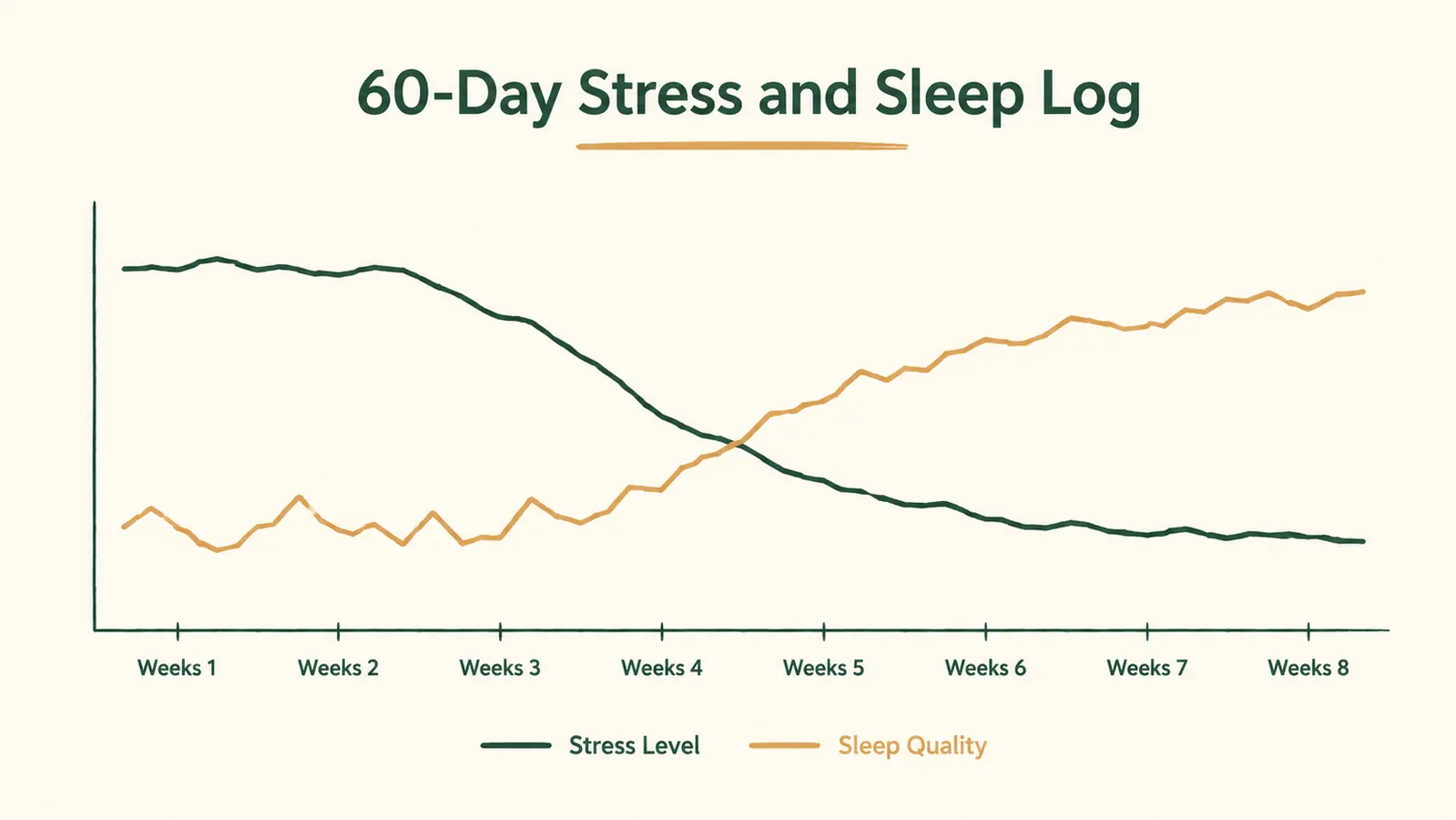
I took two capsules each morning with breakfast, which delivers the full 1,000mg dose the label specifies. I did not change my diet in any significant way, did not add other supplements, and did not reduce my daily responsibilities. I kept a simple notebook, nothing scientific, just a few words each morning and evening: how I slept, what my mind felt like at bedtime, whether the 3 a.m. waking happened, and a rough sense of how my body handled ordinary stress during the day. I tracked for 60 days straight, no missed doses.
What I was watching for specifically: the quality of my sleep in the second half of the night, the speed at which I settled down at bedtime, how I felt during stressful conversations or situations, and whether I noticed any change in my physical energy or mood across the week. I was not looking for a dramatic transformation. I was looking for a quieting. A small, honest shift.
I did not feel anything in the first two weeks. That is worth knowing before you start. I have seen enough supplements come and go, heard enough people say something worked in three days, to be suspicious of quick results with adaptogens. The body needs time to adjust. I told myself I would be patient and I was.
What the KSM-66 Extract Actually Is, and Why It Matters
Most ashwagandha supplements on the shelf are just powdered root. That is fine as a starting point, but the research that actually supports ashwagandha for stress, cortisol reduction, and sleep quality is almost entirely done on specific root extracts, not powder. KSM-66 is one of two well-studied extracts, the other being Sensoril. The key difference is that KSM-66 uses only the root, not the leaves, and is standardized to contain at least 5% withanolides, the active compounds researchers believe are responsible for the adaptogenic effects.
Physician's Choice lists 5% withanolides on their label and includes BioPerine, a black pepper extract that improves absorption. They are third-party tested and the company publishes certificates of analysis. I am not a scientist. But I have spent decades watching people sell things with no accountability, and I notice when a company provides evidence you can look at. That transparency was part of why my doctor friend recommended them specifically.
The research background is real enough to take seriously. Studies on KSM-66 have shown reductions in serum cortisol, improved scores on perceived stress scales, and better sleep quality in populations that included older adults. None of that guarantees results for any individual person. But when I chose to try this for 60 days, I was choosing something with a plausible mechanism, not a hope and a label.
What Actually Changed at 60 Days
The first thing I noticed, sometime around day 18 or 19, was that I was not waking at 3 a.m. every night. I had been waking four or five nights out of seven for the better part of two years. Over the third week, that dropped to two nights out of seven, then by the end of week four it was more like one. I am not telling you it disappeared entirely. I still have nights where something pulls me awake, usually something real worth thinking about. But the pattern of waking for no reason, lying there with a restless mind that would not settle, that was clearly reduced.
What I was looking for was a quieting. Not a miracle, not a transformation. Just a small, honest shift in how my body handled the weight of ordinary days. Around week three, that shift showed up.
The second change was harder to name. My wife noticed it before I did. She said I seemed to absorb things differently. That when something went sideways, which happens at every age in every life, I seemed to return to center faster. I had not said anything to her about the supplement. She just observed it. I take that kind of feedback seriously.
My physical energy did not change in any dramatic way, and I did not expect it to. I am 70 years old. My energy is what it is. What I did notice was that I was not running as low by late afternoon as I sometimes had been. Whether that is the ashwagandha or simply sleeping better, I cannot say cleanly. Those two things are connected.
The Ingredient Label: What I Looked at Before I Ordered
Two capsules deliver 1,000mg of KSM-66 Ashwagandha root extract, standardized to 5% withanolides. That is a therapeutic dose consistent with what is used in clinical studies. Many cheaper ashwagandha products deliver 300mg to 500mg of plain powder, which is a different thing entirely.
The capsule is vegan. The formula contains no fillers I could not identify. The inclusion of 5mg BioPerine is a thoughtful touch. Piperine, the active compound in black pepper, has been shown to increase the bioavailability of various compounds, and its inclusion suggests the formulator was thinking about absorption, not just label weight. I appreciate when the thought shows in the details.
One thing I want to name honestly: 60 capsules at this dose means one bottle is exactly a 30-day supply. Not 60 days, the way the bottle count might mislead you. You will need two bottles for a proper trial. Budget accordingly. That felt like a small frustration worth flagging.
The Tradeoffs I Would Not Leave Out
The slow start is real and worth preparing for. If you try this for two weeks and feel nothing, that is not a sign it is not working. Adaptogens work over time, not acutely. I almost stopped at day 14 because I noticed nothing. I am glad I did not. But if someone is in a genuine crisis state, reaching for an adaptogen as their primary support is probably not the right move. This is a slow medicine.
There is also a question of what you are stacking this against. Ashwagandha interacts with certain thyroid medications and sedatives. I am not on either, but I checked before starting. If you take any prescription medication, it is worth a five-minute conversation with your doctor before adding any adaptogen to your routine. Not because ashwagandha is dangerous, it has a long safety record, but because you are worth that five minutes.
And I will say this plainly: ashwagandha is not a replacement for sleep hygiene, for going to bed at a consistent time, for reducing screen time in the evening, for getting outside during the day. I was already doing those things when I started this. I believe they are the foundation. This supplement appears to support that foundation. It does not replace it.
What I Liked
- KSM-66 extract standardized to 5% withanolides, the same form used in published research
- Includes BioPerine for improved absorption, not just label weight
- Third-party tested with accessible certificates of analysis
- Meaningful sleep improvement became noticeable around weeks three to four
- Vegan capsule with a clean, readable ingredient list
- Over 7,500 Amazon reviews at a strong 4.5-star average
Where It Falls Short
- 60 capsules is a 30-day supply at the full 1,000mg dose, so you need two bottles for a proper trial
- No noticeable effect in the first two weeks, which tests patience
- Ashwagandha is not for everyone, those on thyroid medications should check with their doctor first
- Results vary, my wife noticed before I did, which means the changes can be subtle
- Not a short-term fix for acute stress or crisis-level anxiety

Alternatives I Considered
Before landing on Physician's Choice, I looked at three other brands. One used plain ashwagandha powder with no extract designation on the label. One listed KSM-66 but at 300mg, well below the studied dose. A third had the right extract and dose but no third-party testing I could verify. Physician's Choice was not the cheapest option but it was the one I could trust on both fronts: the right extract form at the right dose, with testing you can look at. If you want to compare ashwagandha to rhodiola, another adaptogen with solid research behind it, I have written about that difference in detail in a separate article.
Who This Is For
This supplement is for adults who are dealing with the low-grade, persistent stress that does not come from a single event but from the accumulated weight of years. People who wake in the night with their mind moving when the rest of them wants stillness. People who are sleeping but not resting. People who are functional but feel like they are carrying something heavier than they used to. It is for people who are willing to be patient for three to four weeks and consistent for at least 60 days before they form a judgment. If that describes you, and you have had that conversation with your doctor, this is worth trying.
Who Should Skip It
If you are on thyroid medication or any medication that affects cortisol levels, please speak with your doctor before starting. If you are pregnant or nursing, this is not the supplement for you. If you are looking for something that delivers results in a week, ashwagandha, and really any adaptogen worth taking, is going to disappoint you on that timeline. And if your sleep or stress issues are severe enough to interfere significantly with your daily life, a supplement is not where you start. A conversation with a qualified practitioner is where you start.
60 days in, I am still taking it. That is my honest answer.
Physician's Choice KSM-66 Ashwagandha is one of the few supplements I have stayed with past the trial period. For nighttime calm and more settled sleep, it has delivered quietly and honestly, which is the only kind of delivery I trust at my age. Check today's price and the current availability on Amazon.
Amazon Check Today's Price on Amazon →