
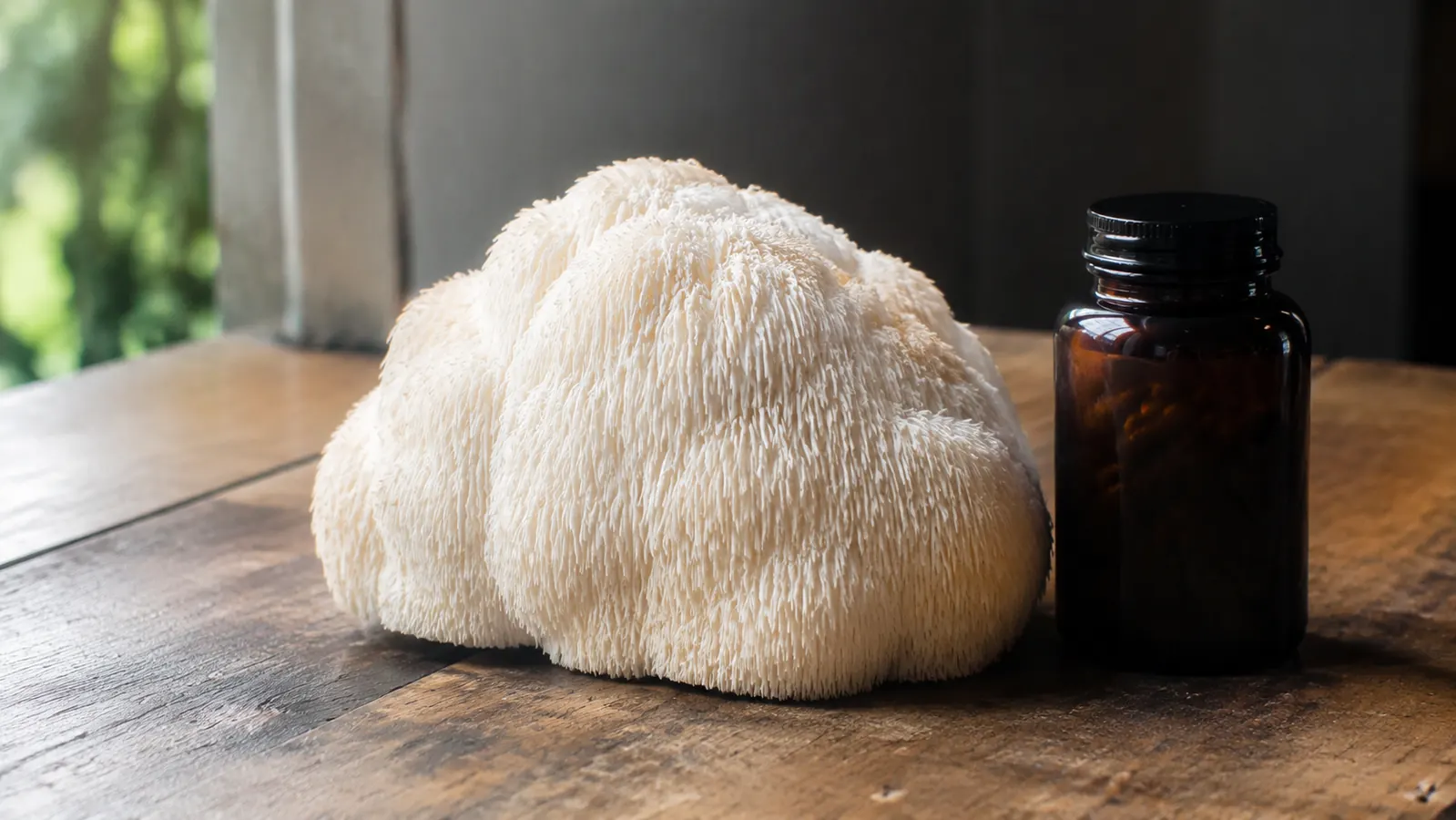
Let me tell you the thing most lion's mane reviews skip past entirely. The product you are probably looking at right now may not actually be lion's mane. Not in any meaningful sense. It may be a bag of grain starch with mushroom roots threaded through it, sold under a name that sounds like the real thing. That is the central problem with this supplement category, and if you do not understand it before you buy, you may spend weeks waiting for results from something that was never going to deliver them.
I am Alexander Kalauli. I am 70 years old, I grew up on this island, and I spent a good part of my adult life learning which plants do what and why. I have been using Real Mushrooms Lion's Mane capsules, ASIN B084JVN2VT, for an extended period now. I am going to tell you what the product actually is, what it is not, what the industry around it is doing that you should know about, what this mushroom genuinely cannot do no matter who makes it, and who probably should not buy any lion's mane product at all. Start to finish, this is the review I needed before I made my first purchase.
The Quick Verdict
Real Mushrooms is one of a small number of brands in this category that actually delivers what the label claims. The product is legitimate. The category around it is not, and that distinction matters more than any review score.
Amazon Check Today's Price →If you have already done your research and want the one that is not cutting corners, here it is.
Real Mushrooms Lion's Mane uses certified organic fruiting body extract with published beta-glucan content above 25 percent. The 300-count bottle is the format most long-term users settle on. Check today's price and see if the math works for you.
Amazon Check Today's Price on Amazon →How I Used It
Two capsules each morning, taken with food. No cycling, no special protocol, no stacking with other nootropics. I kept the same diet, sleep, and exercise habits I have had for years so that I would not confuse the variables. I was not looking for a dramatic transformation. I was looking for whether this compound behaved the way the company said it would, over enough time to see a pattern.
I kept rough notes in a journal. Nothing clinical, nothing that would hold up in a study, but enough to track the direction of things week by week. What I found informed this review. But before I get to that, I want to spend time on something more important: what you need to know about the lion's mane category before you trust any product in it.
The Mycelium Problem Nobody Is Explaining to You
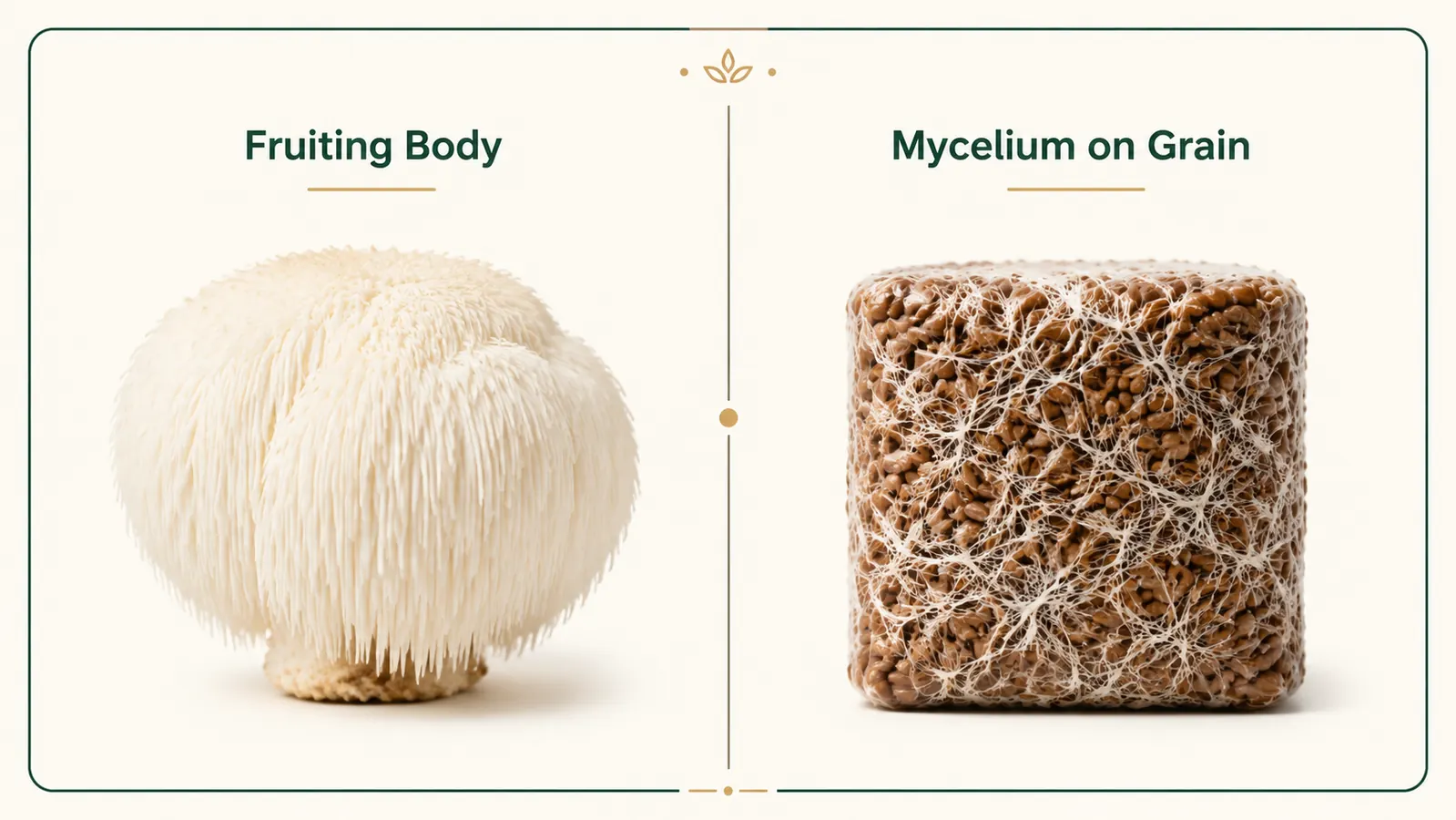
A mushroom has two main parts. The fruiting body is the mushroom you recognize, the cap and stem. It is the part traditional Chinese medicine has used for centuries. It is where the active compounds, specifically hericenones, are most concentrated. The mycelium is the root network, the threads that spread underground or through a growing substrate. Mycelium has useful compounds too, including erinacines, but it cannot be grown cleanly at commercial scale without a grain substrate. Most mycelium-on-grain products end up containing a substantial portion of grain starch mixed in with whatever mycelium compounds are present.
Here is the market problem: growing fruiting bodies takes longer and costs more. Growing mycelium on grain is fast and cheap. So a significant portion of the lion's mane supplement market is selling mycelium-on-grain products. Some of them disclose this clearly. Many do not. When you see a lion's mane supplement at a very low price point with a high milligram count on the label, that milligram count is almost certainly measuring the mycelium-grain mixture, not isolated mushroom extract. You may be paying for grain starch and a trace of mushroom.
Real Mushrooms built their business specifically around not doing this. They use certified organic fruiting bodies, they publish their beta-glucan content as greater than 25 percent on the label, and they make their certificate of analysis available. Beta-glucans are a reliable potency marker. A mycelium-on-grain product that is mostly grain will have low beta-glucan content. A clean fruiting body extract will have high beta-glucan content. That is the number to look for on any mushroom supplement label, and most brands do not show it because they cannot stand behind it.
The Price-Per-Day Reality
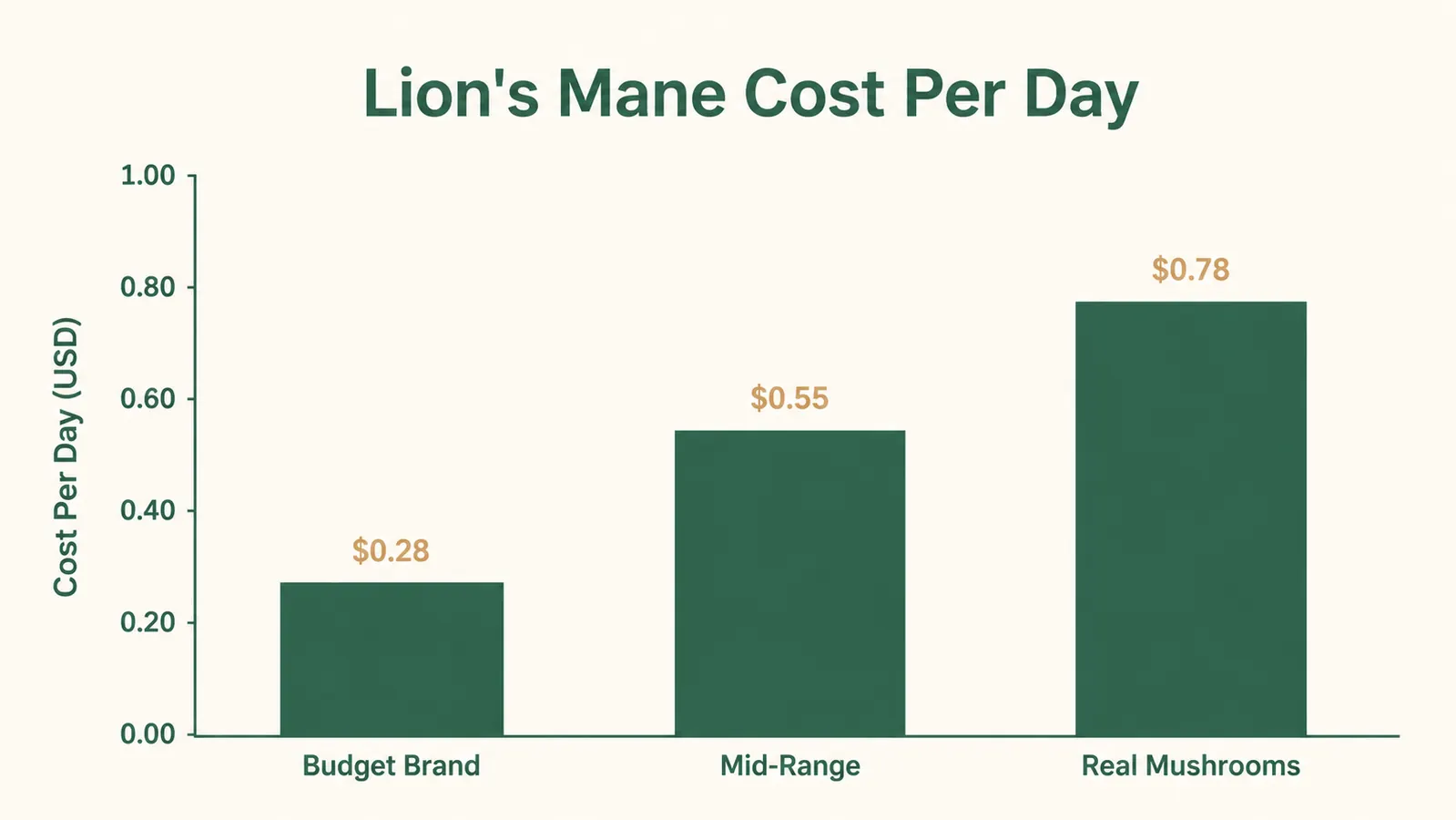
Real Mushrooms Lion's Mane is not cheap. At current pricing for the 300-count bottle, and taking two capsules per day as the standard dose, you are looking at roughly 78 cents per day. Over a year, that is close to $285. For a household on a fixed income, that is a meaningful number, and I am not going to pretend otherwise.
Some people try to make the bottle last longer by dropping to one capsule per day. The research on lion's mane dosage is not precise enough for me to tell you whether half the dose delivers half the benefit or whether there is a meaningful floor below which nothing much happens. What I can tell you is that the clinical studies showing cognitive benefits in older adults generally used doses of 500mg to 1000mg of extract daily, and two of these capsules at 500mg each gets you to the lower end of that range. Going to one capsule brings you below it.
The honest comparison is not Real Mushrooms versus a cheaper lion's mane brand. That comparison is mostly meaningless if the cheaper brand is selling grain starch. The honest comparison is Real Mushrooms versus other legitimate fruiting body products, and at that level the pricing is competitive. A few other quality brands exist in this space. Real Mushrooms sits in the middle of that narrower, more legitimate group, not at the expensive end of it.
What Lion's Mane Cannot Do
I want to be plain about this because the supplement marketing around lion's mane sometimes drifts toward suggestions that make me uncomfortable. Lion's mane does not reverse dementia. It does not stop Alzheimer's disease. It does not restore lost memories or rebuild significantly deteriorated cognitive function. The research behind it is promising and interesting, particularly around nerve growth factor support, but it is early-stage research conducted on modest sample sizes, often in Japan, and none of it supports the idea that this mushroom can undo established neurological damage.
If someone you love has been diagnosed with dementia and you are researching supplements hoping to reverse or stop it, I am sorry to tell you that lion's mane is not that answer. That is a medical situation that requires a medical team. Supplements can be part of a broader wellness picture, but they do not belong where medicine belongs, and a company or a reviewer who implies otherwise is doing you a disservice.
What the research does support, modestly and with appropriate caveats, is that lion's mane may help support cognitive function in aging adults who are experiencing the normal, non-clinical slippage that comes with getting older. The kind where words do not come as fast as they used to, where you lose a thread in a conversation, where concentration requires more effort than it did at 50. That is a real phenomenon and lion's mane may help with it. That is a smaller and more honest claim than what some reviewers make, but it is the one I am comfortable standing behind.
Lion's mane is not medicine. It is support. Those two things are not the same, and keeping them separate matters, especially when the people searching for it are worried about someone they love.
Expectation Calibration: How Long Before You Feel Anything
This is the section that would have saved me some early frustration. Lion's mane is not a stimulant. It does not work like caffeine, where you feel it within thirty minutes. The proposed mechanism, supporting nerve growth factor production over time, is a slow process by nature. Neurons do not grow quickly. The research suggesting cognitive benefits in older adults came from a sixteen-week trial. Sixteen weeks. If you try this for three weeks and feel nothing and conclude it does not work, you have not actually tested it.
In my own experience, I did not notice anything with confidence until around week six or seven. The early weeks were unremarkable. There was no rush of energy, no sudden sharpness, no obvious signal that something was happening. What eventually showed up was quieter than that. A reduction in the mental drag that had become normal for me. A slightly faster access to words and names. A sense of presence in conversations that I had been losing gradually over a few years. None of it was quick or dramatic.
If you are someone who evaluates supplements the way you evaluate medications, expecting a clear and measurable symptom change on a defined timeline, lion's mane will probably frustrate you. Its benefits are cumulative and subjective. You may not notice them clearly until you stop taking it and notice that something small has shifted back. That is a hard supplement to justify financially if you need proof before you commit. I understand that, and I think it is worth naming honestly.
Mushroom Allergy and Sensitivity: Read This Before You Open the Bottle
This is something most reviews gloss over entirely, and it is a real concern for some people. Lion's mane is a mushroom, and some individuals who are sensitive to edible mushrooms or who have a documented mushroom allergy have reported reactions to lion's mane supplements. These reactions range from minor, skin itching or mild digestive upset, to more significant respiratory responses in people with known mold or fungi sensitivities.
If you have ever had a reaction to eating mushrooms, whether shiitake, oyster, or anything else, bring that history to your doctor before starting lion's mane. The same applies if you have asthma that is triggered by mold or fungal spores, since lion's mane, like all mushrooms, is a member of the fungal kingdom. The supplement itself is encapsulated and dry, so it carries less risk than handling fresh mushrooms in quantity, but the underlying biology is the same.
For people with no mushroom sensitivity, lion's mane is generally considered well-tolerated. I have had no reaction at all. But general tolerability statistics do not help the individual who has a sensitivity. Start with one capsule per day for the first week if there is any uncertainty in your history with mushrooms. Give your system a chance to respond before committing to the full dose.
What I Liked
- Fruiting body extract, not mycelium-on-grain filler, which sets it apart from most of the market
- Published beta-glucan content above 25 percent with third-party testing available
- 300-count bottle is an efficient purchase for committed long-term use
- No taste, no digestive upset in my extended use, easy to add to a morning routine
- Company has been publicly vocal about quality standards in a category where most brands stay quiet about sourcing
- 23,000-plus Amazon reviews at 4.5 stars gives a meaningful real-world track record
Where It Falls Short
- Price-per-day at two capsules is roughly 78 cents, which adds up meaningfully over a year
- No effect is noticeable for the first several weeks, which tests patience and financial commitment
- Cannot do what dementia patients and their families sometimes hope it can do
- Benefits are subtle and cumulative, not verifiable in a short trial window
- Anyone with mushroom sensitivity or mold-triggered asthma should clear it with a doctor first
- The category is so polluted with inferior products that even a good brand faces skepticism it should not have to earn
Who This Is For
You are a good candidate for this product if you are 50 or older, you are noticing the ordinary cognitive slippage of aging rather than anything that requires medical attention, you are willing to commit to at least three months without expecting quick proof, and you have done enough reading to understand that you are paying for quality extraction rather than just a high milligram number. If those conditions describe you, Real Mushrooms Lion's Mane is one of the handful of products in this category I would feel comfortable recommending. See also my longer piece on six months of daily use with this product if you want a deeper look at the experience arc.
Who Should Skip It
Skip this product, or at minimum postpone it, if you have a clinically diagnosed neurological condition and are hoping supplements will substitute for medical care. Skip it if your mushroom allergy or sensitivity history has not been cleared by a doctor. Skip it if you cannot comfortably sustain the cost for at least three months, because a four-week trial will tell you nothing useful. And skip it if you need immediate, obvious mental energy improvement because you have a deadline or a project or a season of heavy cognitive demands coming up. This compound is not built for that. It is built for the long direction, not the short one. For a comparison of this mushroom against other medicinal options, my piece on lion's mane versus reishi covers that territory in detail.
If the price-per-day math works and you are ready to give it a real trial, this is the brand I trust.
Real Mushrooms Lion's Mane is one of very few brands in this category that uses certified organic fruiting body extract and publishes verifiable beta-glucan content. If you have read this far and the caveats did not knock you out, you are probably a good fit. Check today's price on Amazon and see where the bottle lands.
Amazon Check Today's Price on Amazon →