

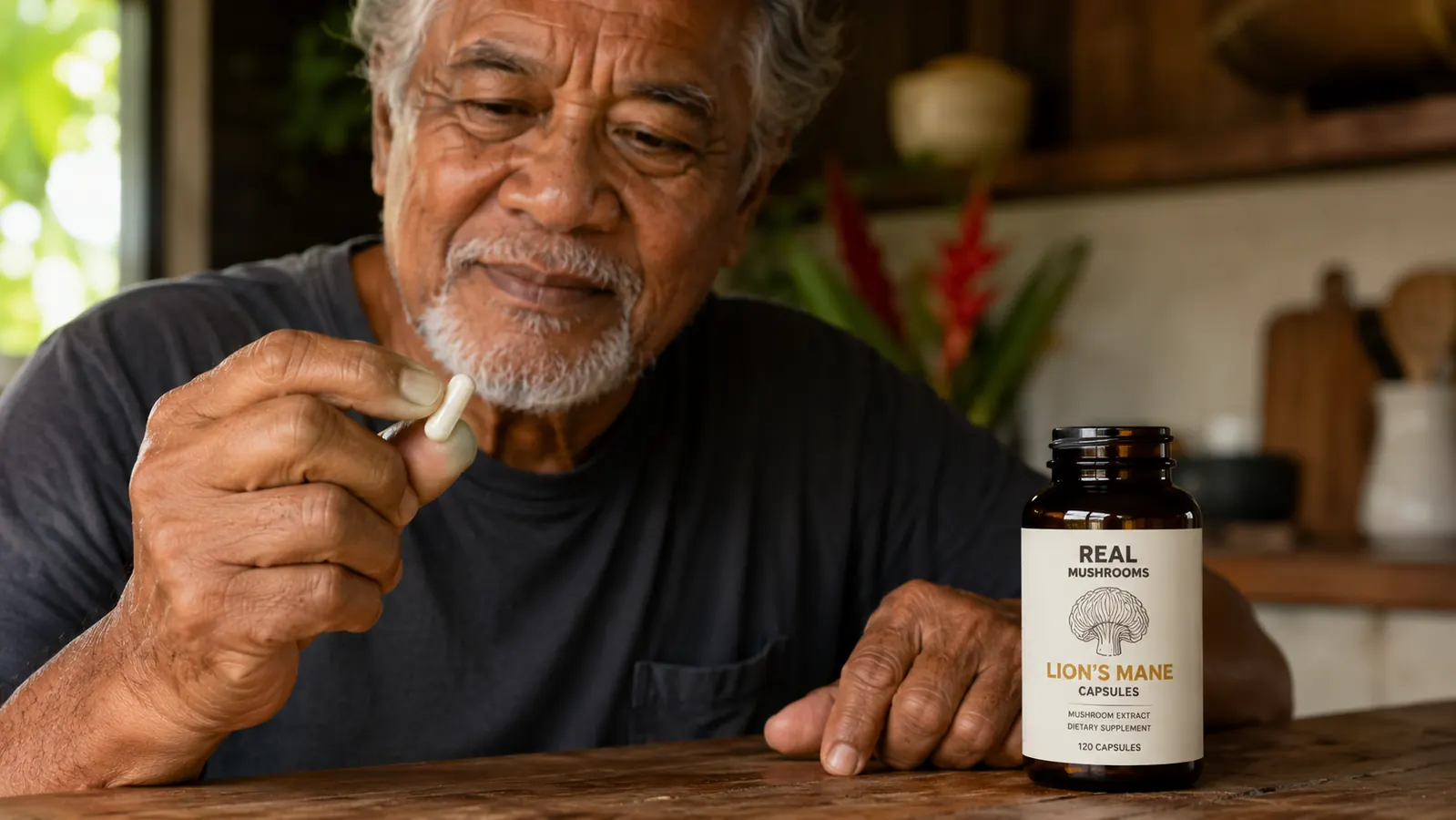
I want to be honest with you about something before I tell you anything else. Lion's mane mushroom is not part of Hawaiian healing tradition. It grows in the forests of Japan and China, not on my island. My tutu did not know it. The la'au lapa'au practitioners who taught me about plants never mentioned it. So when my daughter first showed me a bottle of Real Mushrooms Lion's Mane capsules about eight months ago, my first instinct was to put it down and go make noni tea instead.
But I am 70 years old, and I have been noticing things. Small things. Reaching for a word and finding nothing there. Sitting down to write a letter and losing the thread halfway through the first sentence. Forgetting the name of a man I have known for forty years, then remembering it three hours later in the shower. That kind of thing. It is not dramatic. Nobody would call it alarming. But I grew up watching my grandfather stay sharp until the day he died at 84, and I did not want to drift in a different direction without at least trying something. So I tried the mushroom. I have now taken two capsules every morning for six months, working through most of a 300-count bottle. Here is what I found.
The Quick Verdict
A genuinely honest product from a company that does not cut corners on extraction, and the cognitive effects are real enough to keep me reordering, but the cost is high and the changes are subtle, not sudden.
Amazon Check Today's Price →Your memory is worth more than a hesitation. Here is the bottle I used.
Real Mushrooms Lion's Mane is one of the few brands that uses certified organic fruiting body extract with verified beta-glucan content. No mycelium filler. At 300 capsules, a single bottle lasts close to five months at two per day.
Amazon Check Today's Price on Amazon →How I Used It
The routine was simple. Two capsules with my morning coffee, right after breakfast. I did not cycle it or take weekends off. I did not stack it with other nootropics. I kept my usual habits: a walk most mornings, the same food I have been eating for decades, eight hours of sleep most nights. I wanted to know what the mushroom did on its own, not what a whole protocol did.
I did not keep a clinical log, but I did make notes in the back of a journal I keep on my kitchen table. Observations, mostly. Rough impressions from week to week about how my mornings felt, how conversations went, whether words came easier or harder. Six months of those notes is what this review is built on, along with whatever I noticed while living my regular life.
I started in November, which matters a little. The end of the year can be mentally demanding for any family, and Hawaii is not exempt from holiday noise. So some of what I experienced in months one and two may have been baseline stress and distraction, not a reflection of the supplement at all. I try to account for that below.
What Real Mushrooms Actually Puts in the Bottle
One thing I respect about this brand is that they are transparent about what they are selling. Many lion's mane products on the market are made from mycelium, which is the root structure of the mushroom grown on grain. Mycelium-on-grain products often contain more starch than actual mushroom compounds. Real Mushrooms uses certified organic fruiting body extract, the actual mushroom cap, which is where hericenones and erinacines concentrate. These are the compounds that researchers believe may support nerve growth factor production in the brain.
They publish their beta-glucan content on the label: greater than 25 percent. Beta-glucans are a reliable marker for mushroom potency and immune support. The bottle I have been using shows a third-party certificate of analysis. I cannot verify it myself in a lab, but the fact that they publish it at all puts them ahead of most of the mushroom supplement market. Each capsule delivers 500mg of extract, and at two per day I was getting 1000mg, which is within the range used in the small clinical studies on this mushroom.
Months One and Two: Mostly Nothing, Then Something Small
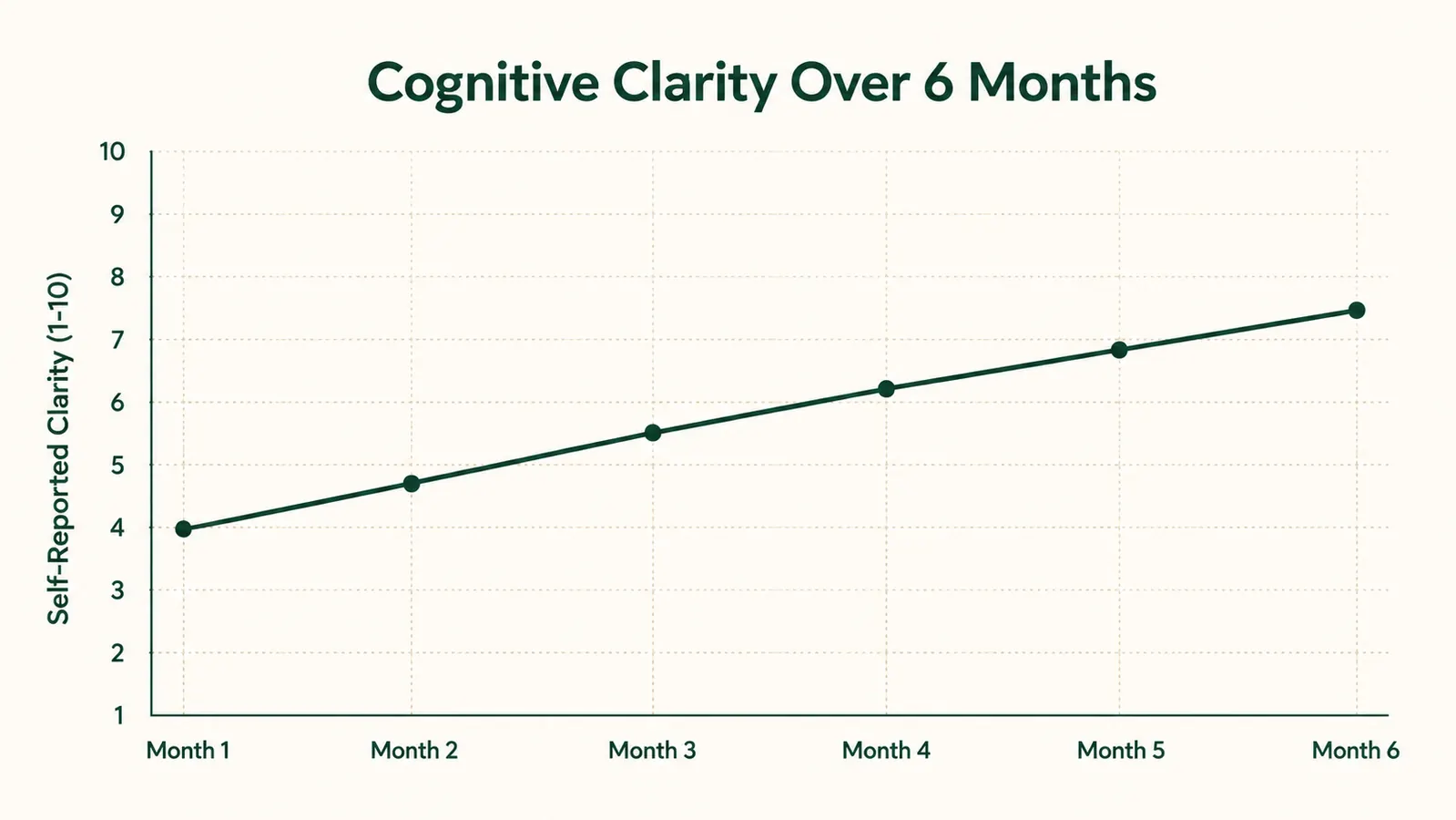
I will be straight with you. The first month, I noticed almost nothing. A few days in the third week where my mornings felt a little cleaner, a little less like I was pushing through fog to get started. But I had also been sleeping well those weeks, so I did not want to give the credit away too fast. My note from week four reads: 'Maybe. Not sure.' That was the full entry.
Month two was more interesting. I started to notice that I was staying with conversations longer. When a neighbor stopped to talk story for twenty minutes, I was present the whole time instead of drifting and nodding. I finished a letter I had been meaning to write for three months. I remembered details from phone calls that I would have normally let slip. None of it was dramatic. It felt more like a quiet lifting than a switch being flipped.
It felt more like a quiet lifting than a switch being flipped. The word that keeps coming to me is 'present.' I was more present.
Months Three Through Six: Where the Real Pattern Showed
By month three, I had enough data points in my journal to see a shape. Word retrieval was noticeably better. Not perfect, but the long pauses where I stood looking at the ceiling waiting for a name or a phrase happened less often. My mornings had a different quality. I am a slow starter by nature, always have been, but the slowness in my mind that had been building over the past few years seemed to settle back a little. Whether that is the lion's mane or something else, I honestly cannot tell you with certainty. But it tracked with the capsules.
Months four, five, and six felt like consolidation rather than new gains. The improvements I noticed in months two and three did not accelerate dramatically. They held. My wife, who did not know I had started taking anything new until I told her after month two, said I seemed less scattered in conversations. That mattered to me more than any chart I could draw.
I also noticed what I think may be a mild immune benefit. I did not get sick once during the winter months, which is not my norm. I usually catch at least one cold between December and February. This year I did not. That could be coincidence. The beta-glucan content of real mushroom extract does have research behind it for immune modulation, so I did not dismiss it entirely.
What I Did Not Like
The cost is the honest objection here. At current pricing, a 300-count bottle covers roughly five months at two capsules daily. That is not a trivial line item for a fixed-income household. I have spoken with people who went to two capsules on weekdays and one on weekends to stretch the bottle further, and they felt the results held. I have not tried that myself, but it is worth knowing.
The capsules themselves are large. I have no trouble with them, but if you have difficulty swallowing large capsules, this would be worth factoring in. There is no flavor, which I consider a benefit. I had expected something earthy or mushroom-forward. There is nothing.
And I want to say plainly: the effects of lion's mane are subtle. If you are expecting to take this and feel sharp within a week the way you might feel coffee working within an hour, you will be disappointed. This is a slow compound. The research suggests it works partly by supporting nerve growth factor production over time. That is not a fast process. People who stop taking it after three weeks and write it off as a scam have not given it a fair test.
What I Liked
- Certified organic fruiting body extract, not mycelium-on-grain filler
- Published beta-glucan content above 25 percent with third-party testing
- 300-count bottle is an efficient bulk purchase for long-term users
- No taste, no digestive upset, easy to add to any existing morning routine
- Cognitive improvements became noticeable by week six to eight for me and held over six months
- Company is transparent about sourcing and extraction methods
Where It Falls Short
- High upfront cost relative to other supplement categories
- No noticeable effect in the first three to four weeks, requires patience
- Capsules are on the larger side
- Effects are subtle and cumulative, not immediately verifiable
- Not a Hawaiian traditional plant, so I had no ancestral framework to place it in
A Word on the Research
I do not put more faith in studies than I put in lived experience, but I do read them. The clinical research on lion's mane for cognitive function in older adults is promising but still early. The most referenced human trial found modest but statistically significant improvements in a cognitive function scale among adults over 50 who took lion's mane extract for sixteen weeks, compared to placebo. The improvements reversed after the supplement was stopped, which suggests the effect depends on continued use. That tracks with what I noticed in my own experience. This is not a cure for anything. It is a support, and you have to keep supporting.
The compounds specific to lion's mane, hericenones from the fruiting body and erinacines from the mycelium, are believed to cross the blood-brain barrier and stimulate production of nerve growth factor. NGF supports the maintenance and growth of neurons. In a brain that is aging, maintaining that process matters. The research is not settled, but the mechanism is plausible enough that I did not feel foolish committing to a six-month trial.

Why I Chose Real Mushrooms Over Cheaper Options
Before I ordered this bottle, I spent a couple of weeks reading what I could about lion's mane brands. The supplement market has a particular problem with mushrooms right now. Because the mycelium grows well on grain substrate and is cheaper to produce than the fruiting body, many companies sell mycelium-on-grain products without clearly saying so on the label. You may be buying mostly grain starch with trace mushroom compounds and paying for something you are not getting.
Real Mushrooms built their brand specifically around this distinction. They have been vocal in the mushroom supplement community about the mycelium-on-grain problem and put their money where their mouth is by using only certified organic fruiting bodies with verified beta-glucan levels. With 23,000-plus reviews on Amazon at a 4.5-star average, they have a long customer track record to match the quality claims. That combination of transparent sourcing, verifiable potency markers, and real-world customer data is what tipped me toward them over a cheaper option.
Who This Is For
If you are 55 or older and noticing the small slippages I described, the word that does not come, the conversation thread you lose, the name you have to chase, then Real Mushrooms Lion's Mane is worth a serious three-month trial. You are not the person who needs a quick fix. You need a compound that works slowly and consistently in the background while you live your life. This fits that profile. It also fits anyone who wants an immune supplement with solid research behind it but does not want to take multiple products. The beta-glucan content covers some of that territory.
It is a reasonable choice for people in their 40s who are trying to get ahead of cognitive decline rather than respond to it. The research on nerve growth factor support suggests earlier intervention may be more effective than later. I wish I had started ten years ago, honestly. But I am glad I started now.
Who Should Skip It
If you are looking for fast, obvious, stimulant-like mental clarity, this is not your answer. If budget is tight and you can only afford to trial something for four to six weeks, you will likely quit before the compound has time to do anything meaningful. Lion's mane asks for patience, and patience asks for financial commitment. That combination rules it out for some people, and there is no shame in acknowledging that.
If you have a diagnosed neurological condition or are taking medications that affect the nervous system, have a conversation with your doctor before adding this. The compound is generally considered safe, but any supplement that influences nerve growth factor is worth a brief medical conversation if your situation is complex. Also worth knowing: some people with mushroom allergies have reported sensitivity to lion's mane. Start with one capsule for the first week if that is a concern for you.
Six months in, I am still reordering. That tells you most of what you need to know.
Real Mushrooms Lion's Mane uses certified organic fruiting body extract with published beta-glucan content. At 300 capsules, this is the long-term buyer's option. If you are ready to give it a fair trial, check today's price on Amazon and see if the timing works for you.
Amazon Check Today's Price on Amazon →For more on how lion's mane compares to reishi and other medicinal mushrooms, see my piece on Lion's Mane vs Reishi. If you want a broader look at the cognitive case for this mushroom specifically, I have also written about 10 reasons lion's mane supports a sharp mind as you age. Neither article will push you toward anything. They are just the reading I wish I had done before I bought my first bottle.