

Turmeric reviews on the internet are mostly the same. Someone takes capsules for two weeks, their knee feels slightly better, they give five stars. I understand that impulse. But I have been dealing with joint pain in both knees and my left hip since I was in my mid-sixties, and in that time I have learned that turmeric is not simple, Qunol is not perfect, and the people who tell you this supplement will change your life are usually the ones who have not been watching it closely enough.
My name is Alexander Kalauli. I am 70 years old, born and raised on the Big Island, and I have been taking Qunol Turmeric Curcumin 1500mg for long enough that I have real opinions about its limits. I am going to share those limits here. Not to talk you out of buying it, but because I think honest information is more useful than cheerleading.
The Quick Verdict
A genuinely good product that is easy to oversell. Works for chronic low-grade joint inflammation in people who are consistent and patient. Does not work fast, does not work for everyone, and comes with real contraindications the label undersells.
Amazon Check Today's Price →Still want to try it? Fair. Here is where I buy it.
Qunol is one of the better-absorbed turmeric formulas on the market. If you have read the caveats below and you still want to try it, the current price on Amazon is the most reliable place to pick it up.
Amazon Check Today's Price on Amazon →What Nobody Tells You About Bioavailability Claims
Qunol makes a big deal of their absorption technology. The label says "ultra high absorption" and the marketing implies you are getting significantly more curcumin into your blood compared to standard powder capsules. That claim is not false. But it is not as dramatic in practice as the packaging makes it sound.
Standard curcumin by itself absorbs poorly, yes. That is well established. Qunol uses a water and fat soluble micelle technology that genuinely does improve absorption over plain curcumin. However, so does black pepper extract (piperine), which costs almost nothing and is included in dozens of generic turmeric supplements that cost a fraction of what Qunol charges. The meaningful comparison is not Qunol versus plain curcumin. It is Qunol versus a decent curcumin-plus-bioperine formula. That gap is smaller than the marketing suggests. If you want to go deeper on that comparison, I wrote about it in my Qunol versus generic curcumin piece.
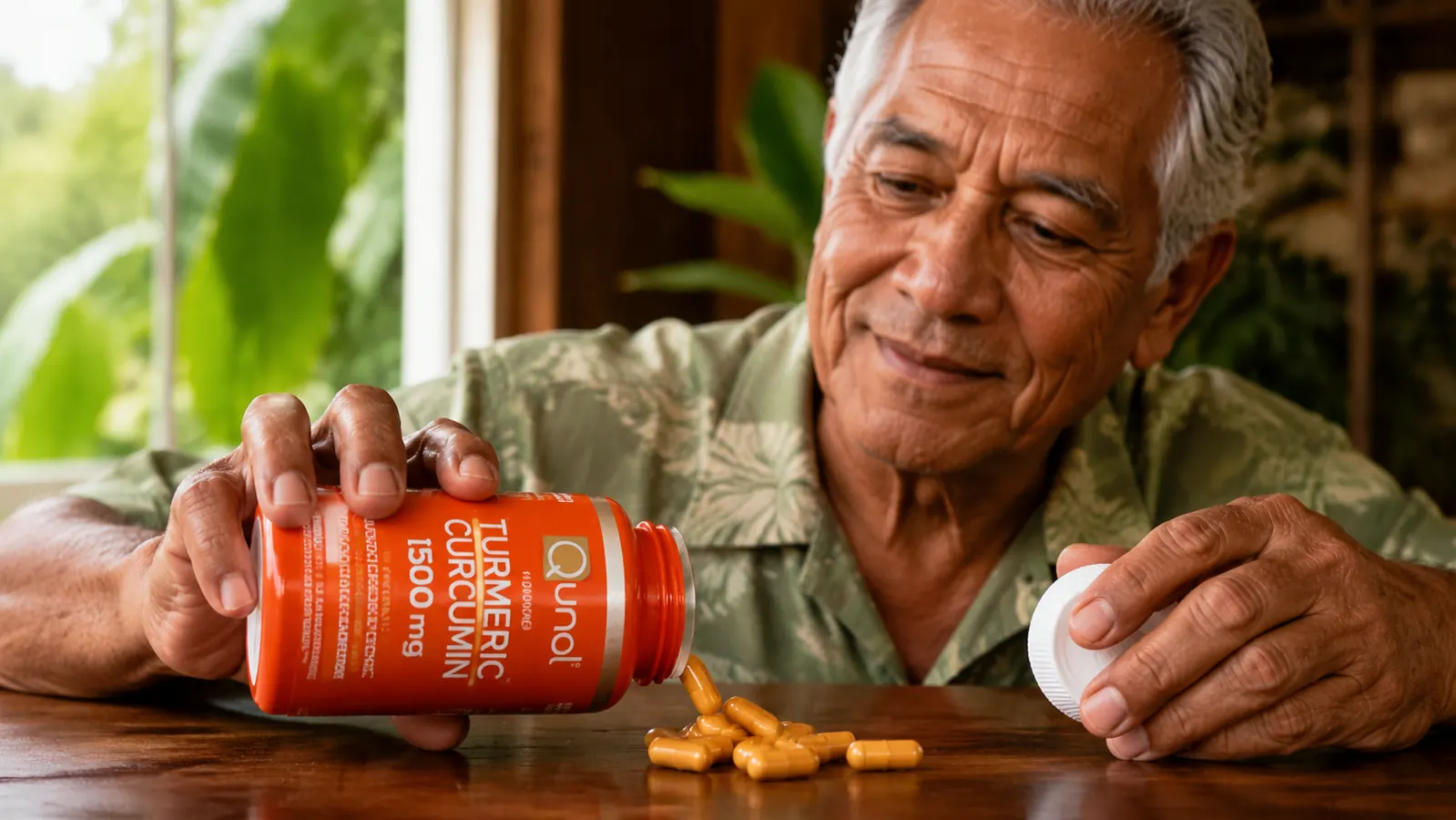
What the label does not tell you is that curcumin absorption also depends heavily on what you eat it with. Fat is a cofactor. Taking this with a dry cracker and water reduces your actual dose. Taking it with a meal that has some fat in it, even a small amount, meaningful improves how much you actually absorb. I eat mine after breakfast, which in my house usually involves eggs fried in a little butter or coconut oil. That habit probably matters more than the micelle technology for my personal results.
The Timing Problem: It Is Slower Than You Think
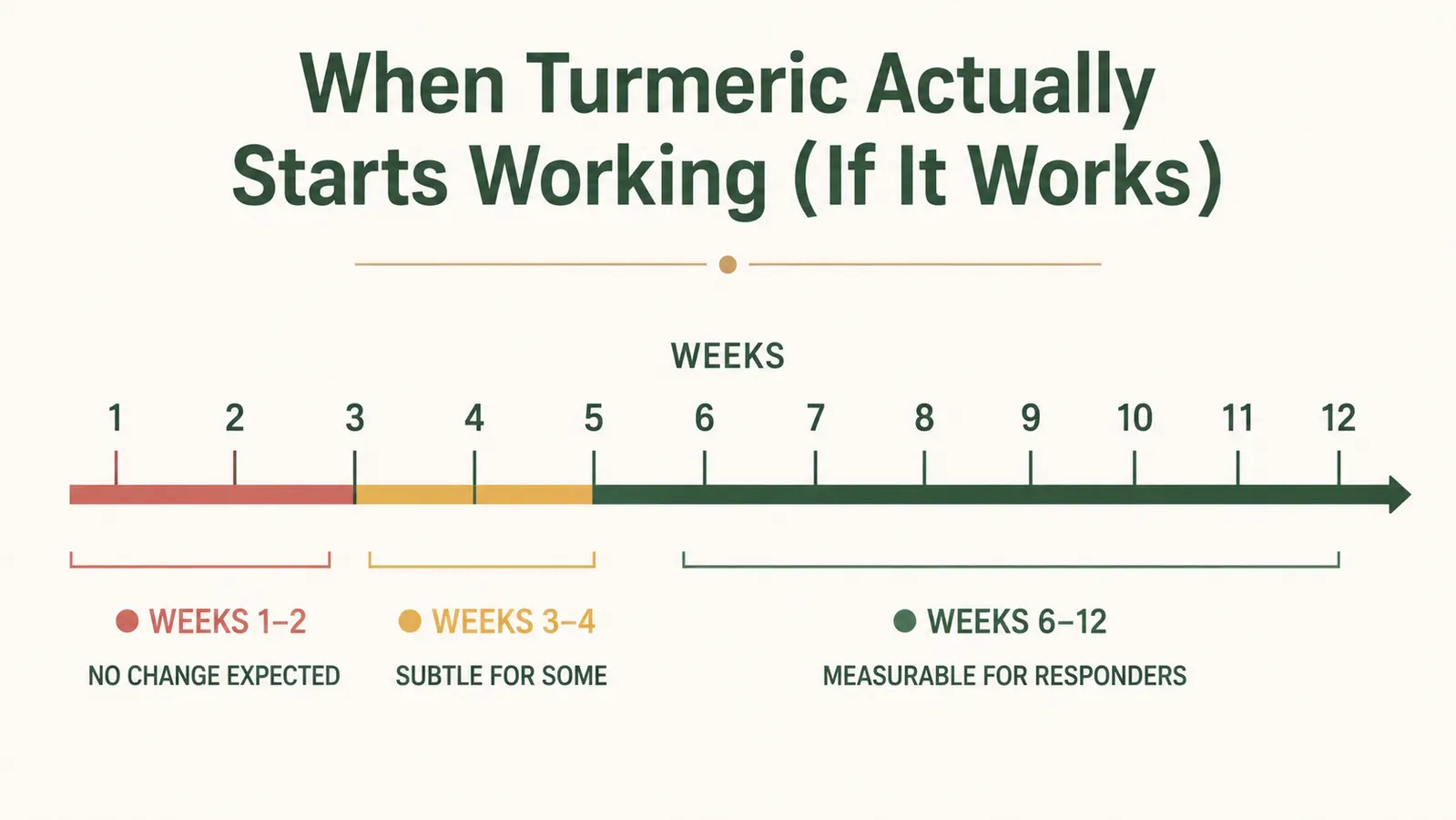
Most people quit turmeric too early. I have watched this happen with my brother-in-law, my neighbor down the road, and two people at my church. They take it for three weeks, feel nothing obvious, and stop. The problem is that curcumin works through inflammation pathways that take time to shift. The research on curcumin for joint pain typically shows results at six to eight weeks minimum, and meaningful results often come closer to twelve weeks.
Qunol's marketing does not emphasize this. The product page implies you will feel something relatively soon. The honest answer is that you should plan to take this for at least two full months before drawing any conclusions. If you are not willing to commit to that, save your money. Short trials tell you nothing about turmeric, and the supplement category is full of people who call it useless because they stopped at week two.
My tutu used to say that a plant does not grow faster because you check it every day. Turmeric works the same way. You have to let it do what it does, on its own schedule.
The chart I put together below is my rough guide to what to expect, and when. It is based on my own experience and what I have observed in people I know. Not clinical data, but real-life pattern.
Contraindications the Label Buries in Small Print
Here is the section most reviews skip entirely. Qunol includes a brief disclaimer on the label about consulting your doctor, but it does not spell out who should actually be careful. Let me be direct about this, because I have seen people in my community take supplements without understanding the interactions.
Curcumin has blood-thinning properties. If you are taking warfarin, aspirin regularly, clopidogrel, or any other anticoagulant, you need to talk to a doctor before adding Qunol. This is not a theoretical concern. High-dose curcumin can potentiate anticoagulant effects, meaning your blood may thin more than intended. For people over sixty who are already on blood thinners, this is worth taking seriously.
Curcumin also stimulates bile production. For most people that is fine or even helpful for digestion. But if you have gallstones or a bile duct obstruction, this can cause problems. The label mentions "consult your physician" without explaining why that advice specifically applies here. If you have a history of gallbladder issues, ask your doctor first.
Finally, curcumin can interfere with how the liver processes certain medications, specifically drugs metabolized by the CYP3A4 enzyme pathway. If you are on statins, chemotherapy, or certain antidepressants, this is a real concern. Again, not trying to scare anyone. Just saying what the label should say more clearly.
The Stomach Issue Nobody Warned Me About
The first two weeks I took Qunol, I had noticeable digestive upset. Not severe, but real. Loose stools two or three times in the first ten days, some bloating, a feeling of warmth in my gut after taking the capsules. I stuck with it and the symptoms faded. Most people who have this experience probably assume the supplement is not agreeing with them and quit. Some of them are right to quit. But some of them just needed to push through the initial adjustment period.
Taking Qunol on an empty stomach makes this worse. I found that taking it in the middle of a meal, rather than before or after, reduced the irritation significantly. If you have a sensitive stomach, start with one capsule a day instead of two. The label suggests two capsules daily, but there is no reason you cannot halve that dose while your gut adapts.
Some people never adapt. A small percentage of people simply cannot tolerate high-dose curcumin regardless of when they take it or how they dose it. If you are three weeks in and still having digestive distress every day, your body may be telling you something. Pay attention to it.
What I Liked
- Absorption technology is legitimately better than plain curcumin powder
- No artificial colors, fillers, or sketchy additives in the formula
- Softgel format is easy to swallow and does not taste bad
- Reliable availability on Amazon with consistent stock
- 4.6 star average across nearly 9,000 reviews suggests a broadly satisfied user base
- Works well for low-to-moderate chronic inflammation when taken consistently for 8-plus weeks
Where It Falls Short
- Takes longer to work than the marketing implies, minimum six weeks before judging
- Blood-thinning interaction is undersold on the label and matters for older adults on medication
- Initial GI discomfort is common and not mentioned prominently on the packaging
- Bioavailability advantage over cheaper piperine-based formulas is smaller than advertised
- Does not address acute joint pain or pain from injury, only chronic low-grade inflammation
- Price per dose is higher than many comparable curcumin-plus-bioperine products

What It Actually Does Not Do
Turmeric is an anti-inflammatory. That is its documented mechanism. It is not a painkiller in the traditional sense. It does not block pain signals the way ibuprofen does. It works upstream, at the inflammation source, which means it can reduce the inflammatory load on your joints over time. But it cannot give you immediate relief. If your knee is swollen and painful today, Qunol is not the answer for today. You need to understand that distinction before you buy.
It also does not repair cartilage. I see this implied in some supplement marketing and it is not accurate for curcumin. Glucosamine and chondroitin have a different theoretical mechanism involving cartilage support. Curcumin is about inflammation management, not tissue repair. If your joint pain comes primarily from cartilage degradation in advanced osteoarthritis, turmeric may help with the inflammation component but will not address the structural problem.
And it does not work for everyone. I want to be honest about this because I think the five-star-heavy review landscape on Amazon can give a skewed picture. Some people take curcumin and feel real improvement. Others take it faithfully for three months and notice nothing measurable. The research shows population-level benefits, but you are not a population. You are one person with one body, and there is no way to know in advance whether you will be a responder.
Who Should Skip This Entirely
You should not start Qunol without talking to a doctor first if you are on blood thinners, have active gallbladder disease, are pregnant or nursing, or are taking medications that depend on the CYP3A4 liver pathway. That is not a generic disclaimer. Those are real, specific groups of people for whom turmeric at 1500mg per day carries real risk.
You should probably skip it entirely, at least in the short term, if you are looking for fast relief. If your pain is bad enough that you need something to work within a few days, curcumin is not that thing. See a doctor. Get proper evaluation. Turmeric is a long game, not an emergency tool.
You should also skip it if you are unwilling to commit to two full months. Buying one bottle, taking it inconsistently, and quitting when nothing obvious happens is a waste of your money and your time. If your intention is to test it properly, commit to two bottles and consistent daily dosing. If that feels like too much, save your money for now.
Who This Is Actually Right For
People over fifty with chronic, diffuse joint inflammation, the kind that is not from a specific injury but from years of wear, weather, and use, are the ones most likely to benefit. People who cannot take NSAIDs regularly because of their stomach or kidneys, and who are looking for a gentler long-term option. People who understand that supplements work alongside lifestyle, not instead of it. My 90-day use piece goes deeper into who saw the most benefit and under what conditions.
People who are patient. That matters more than I can emphasize. The people I know who have gotten real value from Qunol are not the ones who expected miracles. They are the ones who took it quietly every morning for months and gradually noticed that getting out of bed was a little easier, that the stiffness in their hands faded a little sooner each day. That is what this supplement can do. It is real, and it is worth something. But it is not dramatic.
Know what you are getting into? Here is the current price.
Qunol Turmeric is one of the more legitimate options in a supplement category full of low-quality products. The absorption technology is real, the formula is clean, and the user base is large enough that you can read through negative reviews and calibrate your expectations. Go in knowing it will take six to eight weeks minimum, take it with food, and watch for any GI discomfort in the first two weeks.
Amazon Check Today's Price on Amazon →